

Hemlock Development Company has its headquarters right on 810E, in a tiny office that was reserved at the sale of the Schoolhouse Mine to the Unity Corporation. Schoolhouse Mine had once been a pit mine (not unlike Leona’s Dresden Mine) and was the project of Hemlock Development Company in the early part of the century. When the usefulness of quartz in the technological age advanced, Tom Hanford was able to sell the mine, and Unity Corporation has since expanded it into one of the most extensive mining operations in the United States. Silica of the highest quality from Hemlock’s rocks goes into computer chips and cell phones, powering the newly technical world.
Hanford keeps HQ for his development company in the same building, and has scratched out a large lot for his dozers, dump trucks, and other machinery, but the mine no longer belongs to his family. Still, it is not uncommon for people to assume that Tom owns Schoolhouse Mine, which may or may not have been the source of some of last night’s confusion, when protestors visited the headquarters near dusk and slashed tires, broke windows, stole safety gear, and what’s worse, spray-painted their agenda on the sides of vehicles. To top it off, they damaged windows, siding, and vehicles belonging to Unity Corp, no doubt thinking they belonged to Tom.
And the paint is the wrong color. Harris sighs. Sitting in the sun, up two bucks of scaffolding, he considers just using the paint anyway, save himself a trip. But then he pictures his brother’s trucks rolling up and down highway 810 everyday with a two-toned reminder of the vandalism that made the paint job necessary, and reconsiders. He gathers up the bag and begins to climb down the scaffolding, thinking of his mother. She had taught her boys to value each other, and to hold each other up. Even when Tom and Harris were coming of age, and it was clear who was the more pragmatic leader, and who was the more sentimental, there had never been competition or ill demeanor between them. That’s why Harris has insisted on covering up the graffiti himself. Despite his utter uncertainty about the situation at hand, he wants to show Tom that he is not faltering in his loyalty.
“Need help?” Manuel, Tom’s equipment foreman, is hurrying across the gravel lot, sweat lining his brow.
“No thank you Manuel. I bought the wrong color,” Harris shares. “Gonna go back and exchange it.”
“Oh okay. Well, happy to help, sir, if you need.”
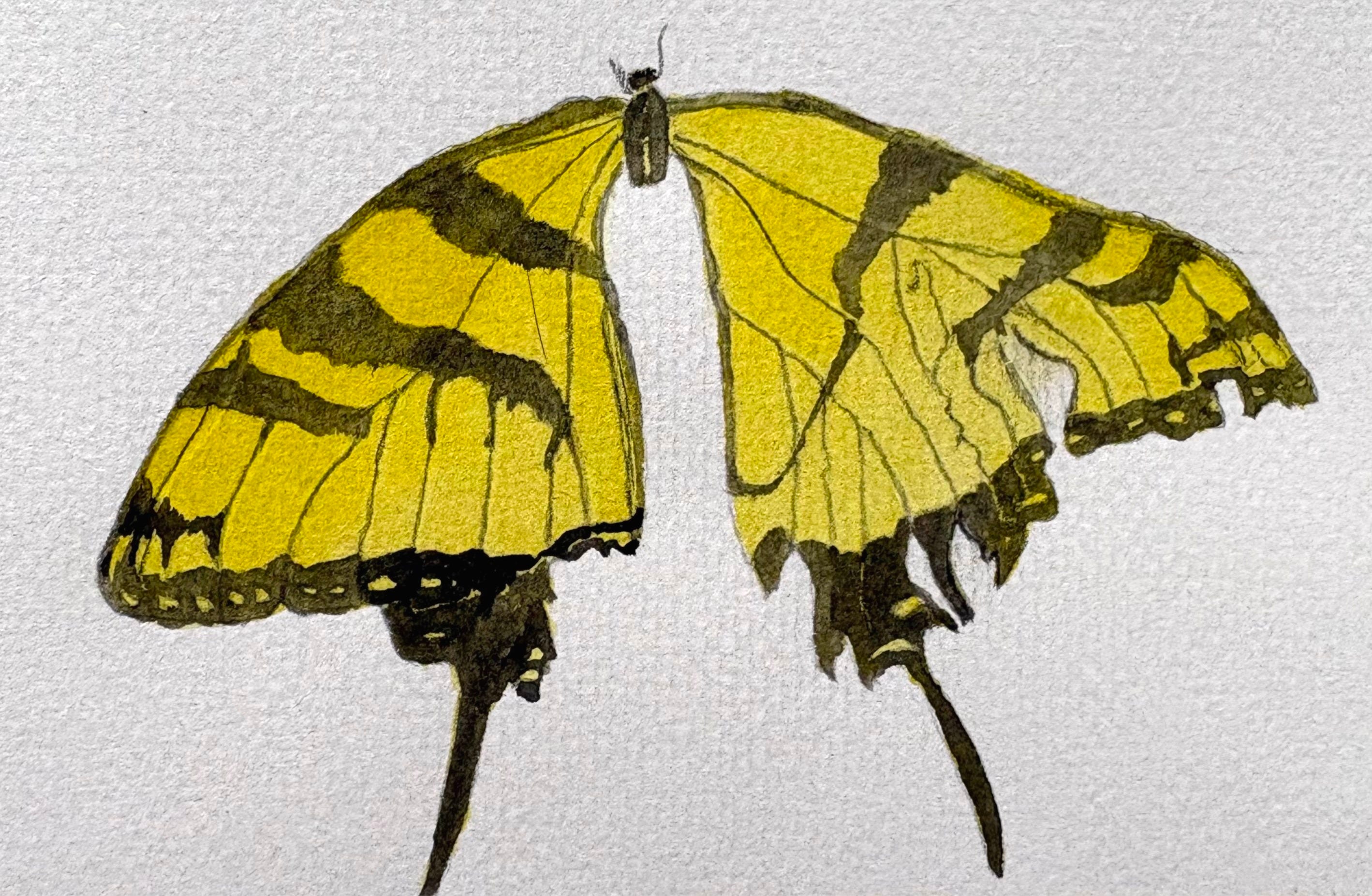
“Thank you, Manuel,” Harris waves, and Manuel gets into his beat-up car, and rattles out down the highway. Harris, alone in the lot now, is struck by the loneliness of his brother’s work, compared to the bustle and communication of managing the Tanawha Lodge. In a way, he envies the difference, though he can’t quite identify the longing that he feels, standing in the August sun. The wind blows, turning up leaves and lifting a fine granite dust into the air. A yellow butterfly hovers in it, seemingly unable to command direction with its flight. Harris coughs, knows the butterfly will die under the slight weight of the dust on its thin wings, knows it will thunderstorm later, despite the sun above him now.
Some of Tom’s trucks are already out on the road, going about business with skulls and crossbones tattooed on their flanks, or “USE BEETLES” written in huge letters across the side of some. But the dump truck still out of commission reads “FREE MAYA M.” in black paint on both sides and the back. Maya. Harris feels a burning sorrow to think that the complexity of saving hemlocks has become about Maya and Tom, when clearly it isn’t.
Harris hesitates, turns back toward the scaffolding and begins climbing it again. He figures painting over the words with the wrong color beats leaving them another day, and he can come back tomorrow with the better yellow. He goes back to work, one hand holding his shirt over his mouth, the other hand spraying the neon yellow paint. If his partner Neil were here, he would scold Harris for not having a proper mask, but Harris begins to enjoy the haze of yellow paint, the sound of the aerosol release, the canvas of mustard and neon steel that spans his visual field. Work that takes over the whole body is good work, the kind he has been missing as he tools about Tanawha Lodge, overseeing the activities of his employees, checking in on guests with a welcoming smile. He stops and allows the fine yellow spray to finish falling over his silver hair, his glasses, and his clothes. He hasn’t covered a fifth of the vehicle side. He sits down and takes a few breaths absent of paint fumes. Gathering the bag of paint cans by the handles, he drops it down to the ground, lays down on the scaffolding and looks up at the muscular clouds, allowing a memory to form.
∞
October 11, 1988: Harris is lying down on hard pavement, looking up at a grey monolith of sky. People mill around him by the hundreds, shouting, laughing. Neil, the magnetic man he has attached himself to recently, is tracing around Harris with a broken piece of chalk. The energy in the air is high voltage. Neil shouts,
“ACT UP! FIGHT BACK! FIGHT AIDS!” just as he connects the line at Harris’ heel.
“Now do mine,” Neil says, smiling. As another protestor pulls Harris up from his place, Neil writes Harris’ name in the chalk outline, and lies down next to it.
“ACT UP! FIGHT BACK! FIGHT AIDS!” They are expecting 2000 people. Maybe more. But all that Harris can think about, here in the parking lot of the Federal Drug Administration in Maryland, is his father.
Harris does not have AIDS. If he did, he would be wearing a white t-shirt and a white bandana, and be locked elbow-to-elbow in the front of the crowd. If he did, he would be dying. But instead, he is among the many who are afraid of getting AIDS, afraid of his father finding out that he is gay.
Neil is planning to get arrested. The crowd will cheer for him when he does. Someone is blowing a whistle, raucous and high, and someone is speaking on a PA system, and someone is on the awning above the office building door, hanging protest signs and lighting little fires. More people are here than there are in all of Hemlock, and more noise and more energy than Harris has ever imagined. He is electric with excitement. He is here. He is out here. This is Neil’s world. This is Neil’s fight. Neil, who came from California after his mentor died, on a wave of anger and fear.
Harris watches Neil push into the crowd toward the doors, pulling off his jacket. His muscles are taut, and they push handsome lines through the black Silence = Death t-shirt Neil got at the last die-in in New York City. Harris follows him, giving in to his enchantment. Bodies close in around them and the autumn air grows thicker. Harris takes off his hat, as they move closer to the line of police officers, some standing with hands in their pockets, laughing at the crowd. Neil reaches back and pulls Harris forward, just as he did the first night they met. He points at the line of policemen. One of them is wearing latex gloves, as if he may be infected with AIDS at any minute. Neil is laughing about it, but Harris is suddenly angry. He lunges, blind, past Harris, into the line.
“He’s wearing gloves! He’s wearing gloves!” Harris yells. His chest has a fire in it. He is yelling, other people are yelling, and they begin to advance on the line. The whistle continues to blow. The crowd is laughing at the cop, cheering Harris’ anger. Someone pushes forward, shoving Harris into the line of policemen. He topples over, catching himself with his hands.
“You alright brother?” One of the activists in white is sitting, elbows linked with other activists at the doorway. His shirt reads: PERSON LIVING WITH AIDS. The protestors are all being arrested. Harris looks up over the line of policemen, searching for Neil, who he finds, smiling, fist in the air. “SHAME! SHAME! SHAME! SHAME!” they yell at the officers, the building, the government. Power. Harris is being grabbed around the waist. He looks back to find the officer in gloves, his mustache a thick brown stain.
Harris is being arrested. He is the last in a long line of men being taken to a paddy wagon.
The last man in white grabs his hand and is saying, “Yes! YES!” to Harris, and shaking his arm by the elbow. “Yes, man!”
“WE’RE GONNA SEIZE CONTROL! WE’RE PISSED!” the men in white are screaming. The whistle continues to blow, shrill and high and piercing. Harris looks back again to see Neil rushing toward the cops and the line of men headed to the paddy wagon.
“Get BACK! GET BACK,” the cop yells at him, but Neil does not obey. Harris is dizzy, he is giddy. He is thinking of his father. Neil’s lips are on his lips, Neil’s fingers are grasping his fingers.
“I’ll be next! Way to go Harris! Way to go! I’ll be next!” Neil is shouting, and the crowd behind him is cheering as Harris is taken away.
But Neil does not get arrested that day at the FDA, and Harris is bailed out by his brother Tom, who has been trying to phone him because their father has died.
“Harris what are you doing in Maryland?” Tom’s voice is worried. “I bought your ticket from New York.”
“I’ll get back to New York.”
“Get back to New York. Then get back to Hemlock. OK?”
“Yeah. OK.”
On the flight back to Charlotte, Harris thinks of his father who will never meet Neil. His father will never know that Harris loves a man. Harris is ashamed and relieved, and Neil is jabbering beside him on the airplane. Neil will come first to visit Harris in his “cute” hotel. Then, exactly one year after the death of Harris’ father, on the anniversary of Harris’ arrest when ACT UP and ACT NOW seized control of the FDA, Neil will move permanently to Hemlock and into Harris’ life. Neil, who is brave and radiant, and unashamed. Alive, the way Harris felt, lying on the Maryland pavement.
∞